
Sometimes the best strategies are not created when business is going well. They are forced by survival mode, when there are few good options left.
In the early 1930s, Pepsi-Cola was in serious trouble.
The company was on the verge of bankruptcy, as it struggled to compete against the dominant Coca-Cola, and faced the extraordinary economic conditions of the Great Depression. Conventional approaches were not working. Consumers were extremely price-conscious, and every purchase was being carefully considered.
For Charles Guth, the man determined to keep Pepsi alive, the situation eventually became so desperate that he tried to sell the company to Coca-Cola. Ironically, Coca-Cola declined.
At first sight, this looks like a story about a struggling soft-drink company that happened to get lucky.
It was not.
It is a story about how constraints can force organizations to rethink the assumptions on which their strategy is built.
And that makes the Pepsi story remarkably relevant to business leaders today.
When the Obvious Strategy Stops Working
Pepsi’s problem was not simply that it had a weaker brand than Coca-Cola.
It was operating in an environment where Coca-Cola already had enormous advantages: a strong brand, established distribution and consumer recognition.
Trying to beat Coca-Cola by playing exactly the same game would have required resources Pepsi simply did not have.
This is an important distinction in strategy.
When a company is under pressure, the instinct is often to ask:
“How can we do what we are already doing, but better?”
However, sometimes the more important question is:
“What if we change the rules of the game and start playing it in a very distinct way?”
That was essentially the question Pepsi faced.
Instead of trying to become a slightly better version of Coca-Cola, the company eventually found a way to make Pepsi fundamentally more attractive to a consumer whose circumstances had changed.
The answer came from an apparently simple observation.
The Power of a Different Value Proposition
At the time, soft drinks were commonly sold in bottles of around six ounces for five cents.
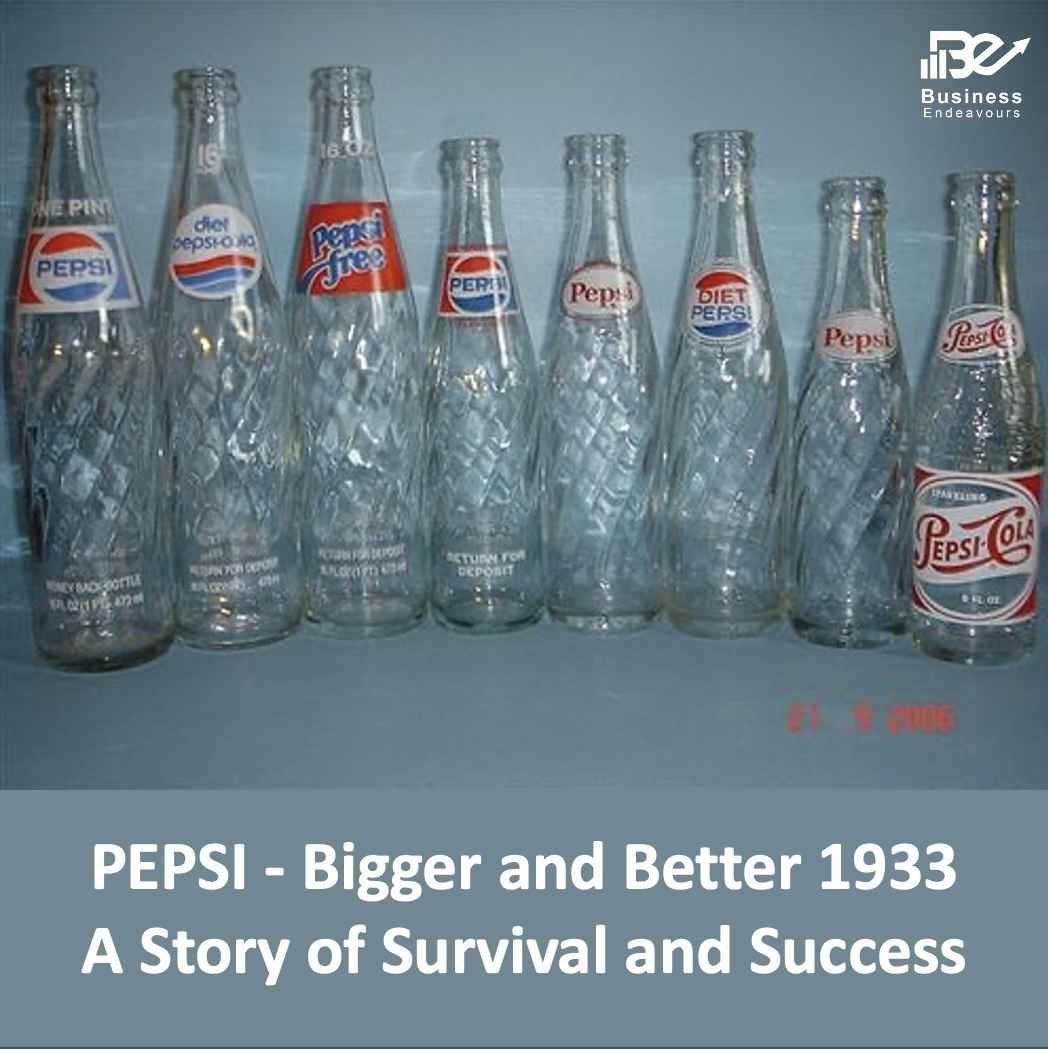
Pepsi experimented with a larger 12-ounce bottle. Initially, however, it was sold for ten cents.
It did not work.
Then came the breakthrough.
What if Pepsi sold the 12-ounce bottle for the same five cents charged for a six-ounce bottle of Coca-Cola?
The economics were challenging. Pepsi would have to accept a lower margin per bottle.
But the strategic logic was powerful.
Pepsi was no longer asking consumers:
“Choose our cola instead of Coca-Cola?”
It was giving them a much simpler reason:
“For the same money, you get twice as much.”
That proposition was particularly powerful during the Great Depression, when consumers were looking carefully at what they received for every cent they spent.
The idea transformed Pepsi’s position in the market. According to historical accounts, the experiment began in Baltimore in late 1933, and demand increased dramatically. Within months, Pepsi was moving more than a thousand cases a day in that market, and the company began building the bottling and distribution capacity needed to expand nationally.
The strategy was not based on having more resources.
It was based on using the constraints to find a different source of value.
Constraints Can Expose Opportunities
There is a powerful lesson here for today’s business leaders.
When organizations encounter a crisis, the natural response is often defensive:
- cut costs;
- postpone investments;
- reduce risk;
- protect existing customers;
- wait for conditions to improve.
Sometimes those actions are necessary.
Sure! But they are not necessarily a strategy.
A crisis changes the economics of the market. It changes customer priorities. It changes competitors’ behaviour. It changes what people are willing to pay for — and what they are no longer willing to pay for.
In other words, a crisis can destroy old opportunities while simultaneously creating new ones.
For Pepsi, the Depression made consumers exceptionally sensitive to value.
That could have been viewed simply as a problem.
Instead, Pepsi turned it into a strategic opportunity.
The company effectively asked:
“What does this new customer value the most?”
The answer was value for money.
Pepsi doubled the amount of product consumers received for their money.
That insight created differentiation with a remarkably simple proposition.
The Pepsi story reminds us that differentiation does not necessarily come from doing more.
Sometimes it comes from doing one thing differently — and making that difference matter to the customer.
What If Your Biggest Problem Is Also Telling You Where the Opportunity Is?
Every business eventually reaches a moment when the old formula stops working.
- A major customer leaves.
- Margins deteriorate.
- A competitor changes the rules.
- Technology disrupts an established business model.
- Consumer behaviour shifts.
- Costs rise.
- Demand falls.
The first instinct is usually to protect what exists.
But perhaps the more strategic question is:
“What is this difficulty telling us about the market?”
The answer may reveal something competitors have overlooked.
A declining market may contain an underserved customer segment.
A cost problem may reveal an inefficient process that should have been solved years ago.
A new competitor may expose an outdated value proposition.
A crisis may reveal that customers value something completely different from what the company has been selling.
The challenge is to distinguish between a problem and a signal to learn from.
The Depression was not an opportunity because economic hardship was somehow beneficial to Pepsi. It was an opportunity because the crisis changed customer behaviour — and Pepsi recognized that change, earlier than its competitors.
The Real Lesson: Strategy Under Pressure
Perhaps the most interesting aspect of the Pepsi story is that its winning strategy did not emerge from abundance.
It emerged from scarcity.
There was not enough money.
There was not enough market power.
There was not enough brand strength to compete head-on with Coca-Cola.
And yet those constraints helped force a strategic question that might otherwise never have been asked.
“If we cannot win playing the same game, can we win by playing a different game or by changing the rules of the game?”
That is:
“If we cannot win by having more, can we win by creating more value with what we have?”
That question is relevant far beyond the soft-drink industry.
It is relevant to a Portuguese SME facing a larger multinational competitor.
It is relevant to a company trying to grow with limited investment.
It is relevant to a management team dealing with falling margins.
It is relevant to leaders navigating uncertainty, disruption or a changing customer base.
Because sometimes the most valuable strategic insight is hidden inside the problem itself.
The Principal Takeaways
- A Crisis Can Change the Rules of the Game
When circumstances change, yesterday’s strategy may no longer be appropriate. Leaders need to understand how customer priorities and market dynamics are changing.
- Constraints Can Stimulate Strategic Creativity
Limited resources can force organizations to challenge assumptions and discover alternative ways of creating value.
- Start With the Customer, Not the Competitor
Pepsi’s breakthrough was not simply about beating Coca-Cola. It was about understanding what mattered to consumers during the Great Depression.
- Differentiation Can Be Remarkably Simple
You do not always need a radically different product. Sometimes one meaningful change in the value proposition can transform competitive positioning.
- Test and Learn — Before Scaling the Solution
The 12-ounce bottle was an experiment. Once evidence showed that consumers responded, Pepsi invested in distribution and expansion.
- Strategy Requires the Courage to Act Under Uncertainty
There is rarely perfect information. Effective leaders learn to make calculated decisions, test assumptions and adapt as evidence emerges.
- Look for Opportunity Inside the Problem
The most difficult business challenges can sometimes reveal the unmet needs, changing behaviours or new sources of value that create the next successful strategy.
The Question for Leaders
When your business is facing its next difficult moment, don’t ask only:
“How do we get through this?”
Also ask:
“What is this difficulty revealing that we could not see before?”
That may be where the next strategy begins.