
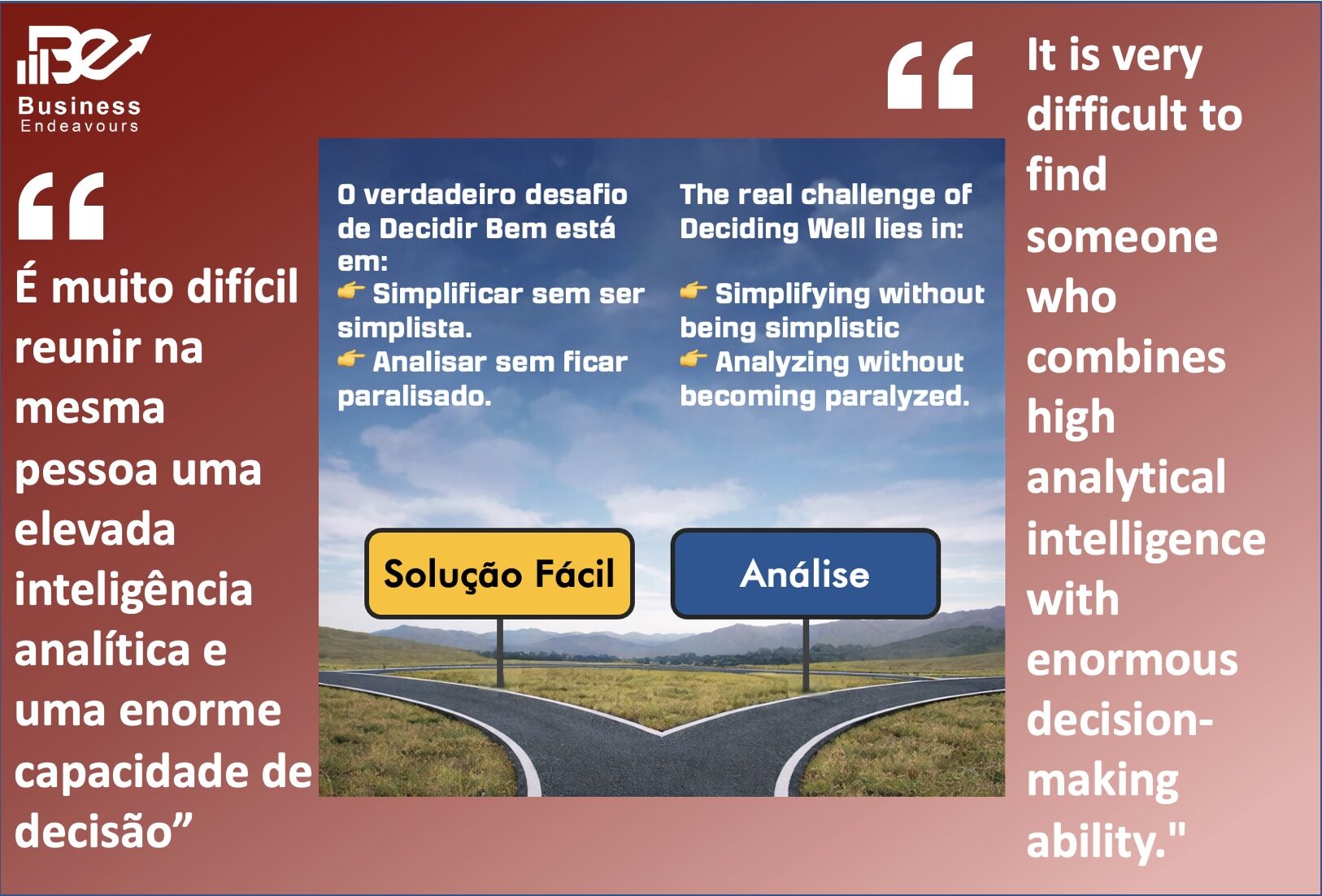
In a world that rewards quick answers, leadership requires something more difficult: knowing how to ask questions, recognising what we do not know, and creating the space to understand before deciding.
When Speaking Becomes More Important Than Understanding
We live in an age in which everyone seems to have an opinion about everything.
Information is permanently available. News unfolds continuously, social media amplifies commentary, and organisations increasingly demand faster answers. In this environment, speaking with confidence can easily be mistaken for knowing; responding quickly can be confused with making good decisions.
But there is a fundamental difference between having an opinion and understanding a problem.
An opinion can be formed in seconds. Understanding takes time: gathering information, confronting different perspectives, identifying assumptions, and accepting that the first explanation is not always the correct one.
The problem is not having opinions, nor is it making quick decisions when circumstances require it. The problem arises when speed becomes a measure of competence and confidence becomes a substitute for knowledge.
In organisations, this confusion can have significant consequences. A perception becomes a conclusion; a conclusion becomes a decision; and a decision becomes a strategy that mobilises resources, people and expectations — sometimes without its underlying assumptions ever having been properly examined.
The risk is not simply not knowing.
The greater risk is believing that we already understand enough.
The Lesson of Socrates: Recognising the Limits of Knowledge
The philosophy of Sócrates provides a useful starting point for thinking about this issue.
The expression frequently associated with the philosopher — “I know that I know nothing” — summarises an attitude of intellectual humility: recognising the limits of one’s own knowledge and refusing to confuse conviction with truth.
It is important, however, to understand that this formulation is a popular synthesis of Socratic thought, rather than a literal quotation appearing in this form in Plato’s dialogues. In the Apology, Sócrates describes his wisdom in relation to recognising the limits of his knowledge and the fact that he does not know what he does not know.
This distinction is not merely academic. The value of the idea lies in the way of thinking it encourages: questioning what we believe we know rather than simply looking for arguments that confirm what we already believe.
For a leader, this attitude does not mean constantly hesitating or avoiding the responsibility to make decisions. It means distinguishing between what is known, what is probable, and what still needs to be investigated.
Intellectual humility is not a lack of confidence. It is the ability to calibrate confidence to the quality of the evidence.
Perhaps this is precisely what makes the Socratic attitude so relevant to contemporary management: within an organisation, recognising uncertainty early enough can prevent it from becoming a costly mistake.
The Illusion of Knowledge in Organisations
Research into decision-making identifies several mechanisms that can undermine the actual quality of judgement.
One of them is overconfidence: believing that our knowledge, predictions or decisions are more certain than the evidence allows. The study “Overconfidence at work: Does overconfidence survive the checks and balances of organizational life?”, published in Research in Organizational Behavior, examines how overconfidence can manifest itself and affect organisations.
Another mechanism is bias — the tendency to interpret information in ways that favour a decision we are already inclined to make. The study “When Deciding Creates Overconfidence”, published in 2025 in Judgment and Decision Making, explored how the decision-making process itself can distort the evaluation of information and increase confidence in a choice, even when that confidence is not justified.
These mechanisms do not mean that leaders are necessarily irrational, nor that experience has no value.
The possibility that a leader’s decisions may be affected by mechanisms such as overconfidence, bias and other cognitive limitations means that experience, authority and conviction do not eliminate the limits of human judgement.
Being aware of this possibility increases the likelihood that our decisions will be informed and grounded in actual knowledge.
In an organisational context, these limitations can become particularly relevant when:
- A decision has to be made under pressure.
- Hierarchy makes it difficult to challenge or question those in leadership positions.
- Past experience is used as an automatic response to a new problem.
- The organisation rewards assertiveness without creating space to test assumptions.
The result can be an organisation that appears decisive but learns little; one that responds quickly but takes too long to recognise when it is wrong.
The Culture That Rewards Answers — and Devalues Questions
The way an organisation makes decisions depends not only on the individual quality of its leaders, but also on the culture that shapes how teams behave.
If, during a meeting, people perceive that disagreeing is risky, that admitting uncertainty may be interpreted as incompetence, or that questioning an existing decision could damage their reputation, they will tend to speak less — or simply say what they believe others want to hear.
Amy Edmondson’s research on psychological safety connects the ability to speak up, collaborate and experiment with organisational learning. Her work also highlights how hierarchy and excessively narrow objectives can increase the interpersonal risks associated with raising questions or expressing concerns.
This helps explain an important tension: a team can be full of highly competent people and still make poorly informed or even unreasonable decisions if it is unable to mobilise the full extent of its collective knowledge.
It is not enough to hire people who can think critically.
Organisations must create the conditions for people to think critically together.
A culture that values understanding should allow questions such as:
- What assumption are we treating as a fact?
- What information are we missing?
- What evidence could contradict our hypothesis?
- Who sees this problem differently?
- What would make us reconsider this decision?
These questions do not necessarily slow down decision-making.
They can help prevent the organisation from moving quickly in the wrong direction.
Thinking Better Does Not Mean Deciding More Slowly
There is, of course, a real tension between analysis and speed.
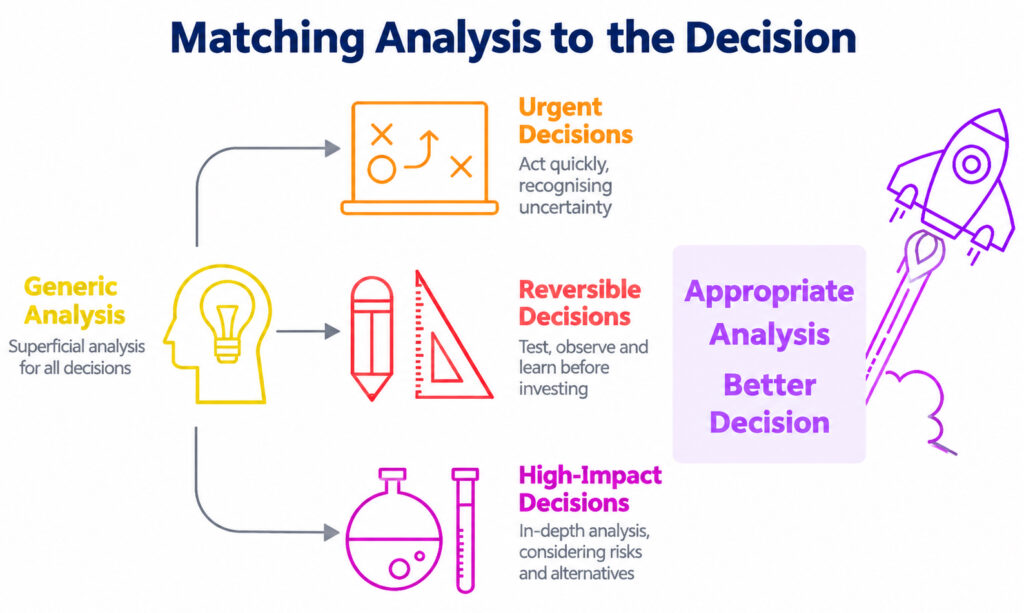
Organisations cannot investigate indefinitely. Some decisions are reversible and benefit from rapid experimentation; in urgent situations, acting with incomplete information may be unavoidable. And there are high-impact decisions — such as major investments, entering new markets or making structural changes — where insufficient analysis can put significant resources and the organisation’s future results at risk.
The alternative, therefore, is not to choose between thinking and acting.
The solution is to match the depth of analysis to the nature of the decision.
A practical way to do this is to distinguish between three situations:
- Urgent decisions When the cost of waiting is high, action may be necessary. The important thing is to make the uncertainties explicit and prepare to review the decision as soon as new information becomes available.
- Reversible decisions When it is possible to change course at a limited cost, it may make sense to test a hypothesis, observe the results and learn before making a larger investment.
- High-impact decisions When significant resources or difficult-to-reverse consequences are involved, greater attention should be given to assumptions, alternatives and risks.
This approach does not eliminate uncertainty.
It helps organisations manage uncertainty consciously.
Thinking well is not about accumulating information indefinitely. It is about identifying the information that could genuinely change the decision.
From Opinion to Decision: Five Practices for Leaders
Intellectual humility only creates value when it translates into concrete behaviours.
It is not enough to say, “Let’s think more carefully.” Organisations need to incorporate that intention into the way decisions are prepared, discussed and reviewed.
- Separate Facts, Interpretations and Assumptions
In a strategic discussion, not all statements have the same status.
“Sales have fallen by 10%” may be a fact.
“Customers no longer value our product” is an interpretation.
“We need to lower our prices” is a possible response.
Mixing these three dimensions can lead an organisation to treat a hypothesis as if it were a conclusion.
To separate facts, interpretations and assumptions, it is useful to ask:
What do we know?
What are we inferring?
What do we still need to confirm?
- Actively Look for Evidence That Contradicts the Hypothesis
It is natural to look for information that confirms what we already believe. But a robust decision should be able to withstand the challenge of opposing arguments.
Before moving forward, a leader can ask the team to identify why the proposal might fail, what evidence would weaken it, or what alternative explanations might exist.
The objective is to contribute to informed decision-making by reducing the risk of decisions based on an incomplete view of the situation.
- Make Space for Different Perspectives
When a team brings together different experiences, roles and perspectives, it can identify aspects that a homogeneous viewpoint may overlook.
Diversity of opinion, by itself, does not guarantee better decisions. Differences need to be heard, examined and incorporated into the decision-making process.
The leader has a fundamental role here: not simply listening to those who agree, but creating the conditions for relevant doubts and disagreements to be expressed.
Research into psychological safety and organisational learning helps explain why this space for speaking up and questioning matters.
- Make the Degree of Confidence Explicit
Not every decision can be made with a high degree of certainty. But it is possible to distinguish between a conclusion supported by strong evidence and a hypothesis that appears plausible but still needs to be tested.
Instead of presenting every recommendation with the same degree of certainty, teams can make explicit:
- What they consider most likely.
- Which assumptions support that conclusion.
- What information is still missing.
- What signals would justify revisiting the decision.
This practice helps prevent confidence in the presentation from being confused with the robustness of the analysis.
- Treat Review as Part of the Decision
A decision should not become untouchable simply because it has already been made.
Defining in advance when and according to which criteria a decision will be reviewed allows organisations to learn from outcomes without turning every change of direction into an admission of failure.
The question is no longer simply:
“Was the decision correct?”
It also becomes:
“What did we learn from what happened, and what should we do now?”
The Intellectual Courage of Leadership
Leadership is often associated with the ability to project confidence, provide answers and make decisions.
But leadership is also revealed in the way someone responds when faced with what they do not know.
Saying “I don’t know” can require more courage than providing an immediate answer.
Asking “What are we missing?” may be more useful than defending the first solution.
Recognising that a decision needs to be reviewed can demonstrate greater responsibility than insisting on it simply to preserve an appearance of infallibility.
Intellectual courage does not mean doubting everything.
It means refusing to allow pride, pressure or the need to appear competent to prevent the search for the best possible understanding.
And this is not the sole responsibility of the leader.
Organisations need teams capable of questioning, managers willing to listen, and processes that allow information and disagreement to be transformed into learning.
An organisation that cannot question its own assumptions limits its ability to learn.
Key Takeaways
- Having an opinion is not the same as understanding. A quick conclusion can be useful, but it may be different from what the evidence actually allows us to claim.
- Confidence does not replace evidence. Experience and assertiveness matter, but they cannot eliminate the limits of human judgement.
- Culture influences the quality of decisions. If questioning is risky, an organisation may stop hearing relevant information.
- Thinking better does not mean analysing indefinitely. The depth of analysis should be proportional to the urgency, reversibility and impact of the decision.
- Questioning assumptions is a management practice. Separating facts from interpretations and actively looking for contradictory evidence helps make reasoning more explicit.
- Reviewing a decision is part of decision-making. Learning from outcomes and adjusting course can be just as important as the initial choice.
- Intellectual humility can strengthen leadership. Recognising limitations, listening to different perspectives and acknowledging uncertainty can create the conditions for more conscious decision-making.
The Question for Leaders
Although the world may seem to demand an immediate opinion on everything, the advantage rarely lies in being the person who answers first.
The advantage lies in matching the depth of analysis to the urgency and importance of the decision — and, accordingly, asking the right questions, recognising what is not yet understood, and creating the conditions for the organisation to think better before it acts.
After all, how many of the decisions we make in our organisations result from a genuine understanding of the problem — and how many simply result from the need to provide an answer?
Before making the next important decision, try asking:
“What do we need to understand better before we decide?”